Showing posts with label commercial real estate. Show all posts

Wednesday, January 9, 2019

Commercial Real Estate in New Orleans East

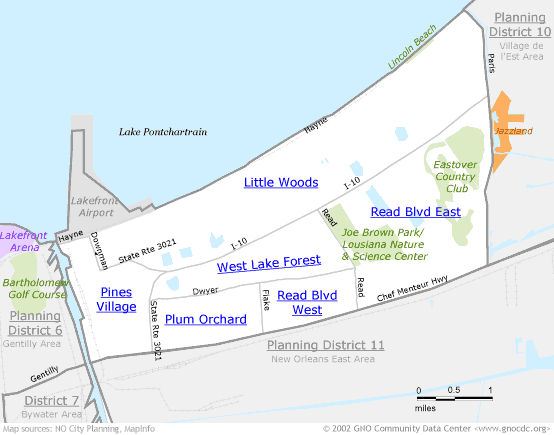
I recently sold the Roadway Inn Hotel in New Orleans, LA on Crowder Boulevard and I-10. This hotel is in the residential West Lake Forest neighborhood, less than a mile from Interstate-10, and lies just eight miles from the historic French Quarter and other local landmarks like the National World War II Museum.


The New Orleans East area is starting to make a comeback in the real estate market. In the surrounding area on Crowder Boulevard, a large church opened in 2019, in addition to several new retail shops being leased on Chef Menteur Highway. Also, in the Lake Forest Plaza area on Bullard Avenue and I-10, they have an investor interested in the development of the area.

Our hope is that within the next five years, this area continues to make improvements.

Lucy Chun
Senior VP | Sales Associate
RE/MAX Commercial Brokers, Inc.
Direct Phone: (504) 838-0001
Mobile Phone: (504) 606-7788
lucychun88@gmail.com

Wednesday, November 7, 2018

The Ins and Outs of a Commercial Lease


You're looking for a new commercial space for your business and have located a property that you believe is the best fit for you. Before you sign that lease, there are a few things that you need to consider:

  • Rent. Let’s start with the basics! When leasing a space, rent is the equivalent of price per square foot. Nobody wants to pay for space they don't need or pay above market price. Make sure you're able to utilize the entire space and make the most out of your square footage. Also, familiarize yourself with market expectations for lease rates.
  • Lease Term. A majority of landlords are looking for a tenant who can commit to an initial term of 2-5 years with the ability to renew the lease. Make yourself aware of when your lease contract begins and ends, as well as when you're responsible for any renewals. You don't want to be blindsided down the road because you didn't have a firm grasp on your lease timeline.
  • Net Charges, Unexpected Costs and CAM. If you find yourself in a net lease or triple net lease, you'll find that there are other expenses to consider besides just your base rent. These leases sometimes include taxes and insurance, as well as common area maintenance charges (CAM). Landlords may also make the tenant responsible for major repairs (roof repairs, HVAC repairs and servicing, plate glass window repairs, etc.).
  • Rent Escalation. It's common in commercial leases to see an escalation in rent over time. The average increase is between 3-5% annually, or anywhere from 12-15% over a five year period.
  • Deposits. Most landlords require a deposit when leasing a space. This could be equal to first months rent. Many times, landlords will also require a tenant to pay the first and last month's rent, especially to a new business whose future may be murkier than that of a longstanding national tenant.
  • Buildout. Each commercial property is different - some come delivered as a ready to go space for the tenant, while others will require a lot of modifications in order to make the space work. Negotiate with the landlord and see if he is willing to do any improvements himself (this is called a Tenant Improvement Allowance). Other landlords may do the buildout for you and amortize the cost of the buildout over the term of the lease. Some may not commit anything to a buildout and grant the tenant a rent abatement to offset some of the costs of building the space out. Always explore your options because each landlord is different!

Every lease is different, and they can be complex and intimidating. Remember to always utilize a commercial realtor and a lawyer before signing a lease. Never blindly commit without understanding the fine print!

Cameron Lombardo
RE/MAX Commercial Brokers, Inc.
clombardo@nolacommercial.com
(504) 838-0001  |  (504) 444-7897


Wednesday, October 3, 2018

Blogging: What Is It Good For? Absolutely Everything

In a world where everyone has a smartphone and access to expressing their opinions, blogging has become the cornerstone of professionals getting their advice out to the public. Blogs can be a great marketing strategy for very minimal cost (if any!) to boost your business, while also educating the reader at the same time.

The important factors in writing a successful commercial real estate blog boil down to five key concepts:

  1. Write on topics that are popular and relevant to the current market. Commercial real estate, like any other business, has trends - make sure to keep up with the current market and educate yourself and your audience on what’s up and coming.   
  2. Include key words or jargon that will show up in a search engine. Make use of the #hashtag - this allows your content to appear in similar searches, thus boosting your audience.
  3. Focus on one key topic to drive home your message. To keep an audience focused, it is always good practice to focus on one topic. Readers can get lost in a sea of information if you are jumping from one thing to the next. 
  4. Keep the topic general and do not focus on yourself. Readers are looking for answers specific to themselves. Simplifying your blog so that it's easy to comprehend is also important. Relating to the reader is a must if you want to keep their attention.
  5. A good blog answers your readers questions. Make a habit of writing down questions you think your readers are asking. Incorporate these questions into your blog.

Why blog? The answer is simple - it generates more leads to your business while also establishing you as an expert on the topic at hand. People tend to find bloggers more credible on a subject if they are willing to go out there and express their opinion on a matter. It is important to be consistent with how often you blog and allow a comments section for readers to give their feedback. This will establish your blog as brand and generate more leads to successfully increase your business.

Starting a blog doesn't have to be difficult. There are multiple outlets online for creating your own blog. Spend a couple hours each week writing down your thoughts and before you know it, you too will be a #blogmaster.

Peter Lombardo
(504) 838-0001
plombardo@nolacommercial.com


Wednesday, September 12, 2018

Opportunity Zones

There was a provision in the Tax Cut and Jobs Act of 2017 (Tax Reform) that flew under a lot of radars,
including those of many in who make their livelihood in commercial real estate-related fields. The
provision – 26 U.S.C. § 1400Z-1&2 – created Opportunity Zones (OZ), which I liken to a combination
between a 1031 exchange and New Markets Tax Credits (NMTC). The program is similar to the 1031
exchange in that it can defer capital gains that would ordinarily be owed following the sale of property
by an investor, and similar to NMTC in that it is intended to incentivize investments in economically
distressed communities.    


What do OZs do? Briefly, they can defer capital gains for five years for investments made in qualified
OZs. After the fifth year, taxes may be cancelled on ten percent of the original capital gains investment
and deferred for the remainder. After the seventh year, taxes may be cancelled on fifteen percent of
the original capital gains investment, and the remainder may be deferred through 2026. And for
investments lasting ten-plus years, investors are exempt from capital gains taxes on the OZ investment
itself, in addition to the other benefits for capital gains carried into the investment.  


It’s a lot to wrap your head around, but once you do, you’ll concur that this is an incredible program.
Other commentators have realized that as well, penning articles titled An Unlikely Group of Billionaires
and Politicians has Created the Most Unbelievable Tax Break Ever and Opportunity Zones: Building the
Plane While Flying It.  


Two logical questions about OZs are 1) where are they, and 2) where can I get more information on
them?  


Each state’s governor proposed OZs, which were subsequently approved by the Department of
Treasury. In Louisiana, many proposed OZs were generated via suggestion by economic development
agencies. Louisiana Economic Development, the largest such agency, has put together a neat GIS tool
showing OZs across the state. Here’s a capture of their location within the city of New Orleans
(highlighted in blue):


And here’s a zoomed in image of their location within New Orleans’ historic core:


Per the text of the Tax Reform bill, the aim of the OZ program was to identify “lower-income census
tracts”, including those with poverty rates of at least twenty percent, or those with median family
incomes of no more than eighty percent of statewide or metro area family income. I would argue that
some of the identified census tracts, while perhaps meeting the letter of this portion of the law, likely
don’t meet it in spirit. But nevertheless, it’s likely that decision makers also took into account areas
which were likely to support the additional new investment that OZs are anticipated to encourage.
And with the already existing momentum in many of the OZs, such support shouldn’t be a problem.  


Getting back to the location of the OZs, you’ll see that large swaths of core neighborhoods – from the
Warehouse District, Central Business District, Central City, Treme and Mid-City – are included. That
means – you guessed it – opportunities await investors who can secure investments in these areas.  


The concept of OZs can be difficult to wrap one’s head around. Luckily, plenty has been written about
the nascent program since it came into existence less than one year ago. You can go direct to the
source with IRS’ FAQs, or Treasury’s Opportunity Zones Resources. Or you can seek out guidance from
the private sector, like Novogradac & Co.’s Opportunity Zones Resource Center. For those readers in
New Orleans (or for those looking for an excuse to travel to New Orleans), Novogradac & Co. is also
putting on a first-of-its-kind Opportunity Zone Conference here in October.  

I can’t tell you how much tax savings you stand to benefit from by investing in an OZ. And I can’t
advise you on the partnership structure of your OZ investment. But I, and the other agents in our
office, can certainly help you locate investment opportunities within the boundaries of qualified OZs.
Please reach out to let us know how we can help!  

Jonathan Shaver, CCIM
jshaver@nolacommercial.com
(504) 838-0001
(504) 579-4082

Wednesday, August 8, 2018

Staying Ahead of Information in the World of Commercial Real Estate


There has never been a better time for access to information about the commercial real estate industry. Whether you are a seasoned investor, a first-timer getting started on your first property, or just curious about the industry, with a few clicks of the mouse there is a wealth of knowledge at your fingertips.

Here are three things I do every day to stay on top of things in the world of commercial real estate:

1) Listen to a podcast.

Podcasts are terrific and portable sources of information. They are better than talk radio, and there is almost no level of detail to which you can't drill down to find the exact info you seek. Although there are numerous podcasts specific to commercial real estate, I tend to favor shows that are more investment-based in their approach, but still deal with CRE. Three shows I tend to favor are:
  • Bigger Pockets. This show is more or less the gold standard of real estate investment podcasting. Their most recent episode (as of the writing of this blog) is #290 “7 Paths to Financial Independence” and it is an exceptionally good listen.
  • Real Wealth Show. Always real estate focused, lots of multi-family information, useful information, always.
  • Invest Like the Best. This show is more traditional capital market focused, but still has good discussion about investment principles.

2) Read a blog post.

A quick Google search can bury you in CRE blogs but I tend to gravitate towards the ones that speak to brokers and broker development. By preparing yourself as a broker, anyone can get an insight into the investment side of the industry. Again, this list probably changes weekly, but lately some of the ones I seem to keep going back to are:

3) Read a Book

Who has time to read books? Simply put, if you’re not reading, you’re not learning. A few of the books I find myself picking up more often than not for either reference or perspective include:
  • What Every Real Estate Investor Needs to Know About Cash Flow by Frank Gallinelli. There is a lot of Real Estate Investment 101 in here, but that’s okay. When I started in the industry, I don’t think there was a book I referenced more frequently than this one.
  • Investing In Real Estate by Gary W. Eldred. If I didn’t know any better, I’d say that Mr. Eldred took a few of the CCIM course manuals and used them for a framework to write a book, but that’s perfectly fine because this book, though slight in size, leaves no method or metric of real estate investment uncovered.
  • The Millionaire Real Estate Agent by Gary Keller. Written by the founder of Keller-Williams, this book is written for residential realtors, but there are mounds of good information that can be gained by just about anyone in the real estate industry.
  • Right now I’m reading Never Split the Difference: Negotiating As If Your Life Depended On It by former FBI hostage negotiator Chris Voss. Simply put, it's an essential read for anyone who negotiates anything (which is pretty much all of us).

When it comes to information about commercial real estate, the internet is your friend, and indeed, the groundswell of information can seem overwhelming but if you start someplace and take the information in bite-sized chunks, you'll begin to see what works and what doesn't. The important thing if you want to get ahead in the field is simply to start somewhere.

Jon Smith, CCIM
RE/MAX Commercial Brokers, Inc.

(504) 838-0001  |  (504) 330-4879
jsmith@nolacommercial.com


Wednesday, July 11, 2018

The Rise of the Machines in Real Estate


We are entering an era of intimate intercourse with technology. We are cyborgs (cybernetic organisms). Each of us has a little device in our pocket or on our person with access to millions and millions of pages of information, anything from funny videos to the weather in Mozambique, the ability to record daily life or to find a mate. Even the simplest of minds has the capacity to access more knowledge than the most brilliant of minds. Technology has allowed people to market and reach an audience that would have been price prohibitive in the past and it has and will continue to cause serious disruption with the “old” way of doing things. Multiple companies and even entire industries have been decimated. We must confront the idea that we may be making ourselves obsolete through the sheer ubiquity of technology. The real estate industry is no exception; we have seen huge changes in the last decade or two with the democratization of information.

How do we balance the exponential explosion created by technology and the simple human, who has remained relatively unchanged for thousands of years? How can we assert value in a world where barriers for many industries have either collapsed or been completely rendered meaningless by technology?

Within the real estate industry, we can already see the disruption caused by technology and its double edged sword; on one side we are able to work from anywhere, send listings off around the world, use mapping technologies to better assess areas, research properties, explore zoning and expand our reach far beyond our local areas; and on the other side of the equation many of the same technologies are available to our prospective clients as well. They, too, can leverage the technology and search for properties, market and sell their property, set alerts for areas and do many of the same things that they would be contracting an agent to do. My clients send listings to me as often, if not more often than the other way around.

So, again, have we planted the seeds of our own obsolescence or how, do we as agents create a value proposal that ensures our survival and the survival of the industry at large?

What intangibles do we bring that cannot be replaced?

In my experience, there are always going to be those that just don’t get it. Why am I going to pay an agent for what I can do myself? On the other side, there are those who are more than happy to turn things over to a professional for any number of reasons. If someone does not see the value in contracting an agent, there is little chance that I am going to convince them of the benefits of hiring someone to represent him or her. I think of abstract art and those who say, well I could have painted that. I am not going to convince that person of the value I bring to the equation so it is not worth my time. On the other side I need to realize that what is going to keep a client and ensure my success is going to be earning their trust and instilling the relationship with the knowledge that I will only ever act in their best interest, that I will work tirelessly to find solutions to their problems, and that I will be there for them when they need advice or guidance and that whatever money I earn in the equation, what I return to them goes far beyond any dollar value.

I would never let a robot or my Roomba babysit my kids because I want someone there who is and will be accountable, who I can call or who will call me if the need arises. I want to know that someone I trust is looking out for and caring for them.

There is a tremendous value to human contact and accountability and that is something that cannot be easily replaced. I view and vet all properties as though I am considering them for myself and advise my clients as such. It is very true that you don’t know what you don’t know and if someone has not had that experience or has had a previously poor experience it can be very hard to work against that preconceived notion. We all have unique qualities and traits that we bring to the equation, whether it is our specific knowledge about a market area or esoteric information about tax incentives, or simply our advice and sense of humor (humor being one of the most difficult things to program in to an artificial being).

The machines are on the rise but they have yet to replace real human interactions, a smile and handshake, intuition, the nuances of negotiation and the assessment of decisions based on parameters that go far beyond ones and zeroes.

Mike Mito
RE/MAX Commercial Brokers, Inc.
3331 Severn Ave. Suite 200
Metairie, LA 70002
(504) 838-0001
mmito@nolacommercial.com


Wednesday, June 6, 2018

ADA Education and Reform Act of 2017


Many people have heard of drive by lawsuits but don't know much about the term other than the words "extortion" or "blackmail." People hear the stories through friends or on the news, shake their heads and walk away. I will admit, I was one of those people until a transaction I was a part of got caught up in one. Now I am an advocate for reform.

The definition of drive by lawsuit as described by Forbes Magazine in December of 2017 is this: "drive-by lawsuits involve allegedly injured plaintiffs who never actually attempt to patronize a business, but simply drive business to business collecting addresses and notating minor and technical violations of the law. With these pieces of data in hand, they then file hundreds of lawsuits utilizing the same or similar language, and in most cases, merely change the name and address on a boilerplate complaint. Business owners, in most cases small, family-owned enterprises, must choose between paying a shakedown settlement or spending several times that amount to fight it in court."

The American with Disabilities Act (ADA) was passed by Congress in 1990 and was later amended in 2009. It was the nation's first comprehensive civil rights law focused on addressing the needs of disabled Americans. There are several different parts to the ADA, but the part that gets the most attention from dive by lawsuits is Title III.

Title III deals with public accommodations, i.e., making facilities and websites accessible to those with disabilities. Title III has provided significant benefits to individual with disabilities, and the law is obviously well-intended. However, it has been taken advantage of by many people looking to profit off of hard working business owners. Luckily, a bipartisan solution was passed in February 2018 to help business owners with this problem: the ADA Education and Reform Act of 2017.

This bill requires the Disability Rights Section of the Department of Justice to develop a program to educate state and local governments and property owners on strategies for promoting access to public accommodations for persons with disabilities. The program may include training for professionals to provide guidance of remediation for potential violations of the ADA of 1990.

The bill prohibits civil actions based on the failure to remove an architectural barrier to access into an existing public accommodation unless: (1) the aggrieved person has provided to the owners or operators a written notice specific enough to identify the barrier, and (2) the owners or operators fail to provide the person with a written description outlining improvements that will be made to improve the barrier, or they fail to remove the barrier or to make substantial progress after providing such a description. The aggrieved person's notice must specify the circumstances under which public accommodation access was denied.

The Judicial Conference of the United States must develop a model program to promote alternative dispute resolution mechanisms to resolve such claims. The model program should include an expedited method for determining relevant facts related to such barriers, as well as steps to resolve accessibility issues before litigation.

HR 620 provides a time period to fix the alleged violation or make substantial progress to resolve it. If the property owner fails, the plaintiff has the right to pursue action that the ADA provides. This legislation addresses an unintended consequence of the ADA that has been allowed to flourish over time, tarnishing an otherwise landmark, life-changing law.

The ADA is one of the most important civil rights laws of our time and I believe HR 620 will have positive changes made to assist the disabled community and benefit society as a whole.

Matt Eaton, CCIM
RE/MAX Commercial Brokers, Inc.
meaton@nolacommercial.com
(504) 838-0001
nolacommercial.com

Tuesday, March 6, 2018

Big News for the Big Easy


I recently attended a presentation by Dr. Loren C. Scott to the GNO, Inc. Investor Group on the proposed industrial expansion of oil prices impacting the New Orleans region.

An amazing industrial boom is coming our way - and one that's highly concentrated geographically. From Baton Rouge to New Orleans alone, $53.2 billion is expected to come in - that's 50x better than in other southeastern states!

Of the $170.4 billion of state of Louisiana projects predicted by the GRIMA survey, the New Orleans MSA expects to see $37.3 billion, with $11 billion already underway and $26.3 billion at the FEED stage. Yuhuang Chemical leads the pack with $1.85 billion worth of industrial construction either completed or underway. Other big spenders include Monsanto ($975 mm), Entergy ($869 mm), Dyno Noble ($850 mm) and more. There's a lot of potential industrial construction on the line as well - Formosa Plastics ($9.4 billion), Venture Global LNG ($8.5 billion), IGP Methanol ($3.6 billion), etc.

In 2020, IGP Methanol will open a $3.6 billion 4-plant methanol facility at Myrtle Grove in Plaquemines Parish, which will bring over 300 jobs to the area. Venture Global LNG's project at the Port of Plaquemines will bring in 220+ jobs with an average wage of $80,000; the Port of New Orleans is hoping for a similar project in St. Bernard as well.

In New Orleans, DXC Technology's new digital transformation center plans to hire 300 IT & business enterprise professionals in 2018, ramping up to 2,000 over the next five years. Chevron is also expanding operations in Covington, and will employ about 550 by the end of 2018, a figure higher than ever before.

I am excited to see all of this development as more industry equals more jobs, and more jobs equals a stronger economy. Bring on 2018!

Richard Juge, CCIM, SIOR
Owner | Broker
RE/MAX Commercial Brokers, Inc.

rjuge@nolacommercial.com
(504) 838-0001
nolacommercial.com

Thursday, January 11, 2018

Longevity in Commercial Real Estate: the Plan


Real estate is always changing. I am often posed the question, “How many years have you been in business?” My usual reply: “Over 40 years, but longevity is not what makes me a successful businessman.” Years of experience is not what makes the agent – hard work and constantly refining your negotiation skills is what will keep you ahead of the rest of the field.

When I am trying to land a listing, the owner/landlord does not care about your “greatness,” but how you apply that greatness to benefit working with you over other agents. Years of experience mean nothing without something to back that up. I have managed to last this long because of my skill set. Anyone can sit at a desk for 40 years in real estate, but this does not measure their success.

The real estate game is often seen by the outside world as “easy money” and many try to jump into it, only to end up failing. The key to longevity in real estate is to ask yourself, “What separates me from everyone else?” The answer is simple: YOU MUST HAVE A PLAN! You cannot sit at a desk waiting for the phone to ring.

THE PLAN

  • Strong negotiating skills: You can never have enough experience in this area. Every year I make it a point to attend seminars on negotiations. This is the most valuable tool in your repertoire. Many deals end up falling through because of poor negotiation skills. Make sure each year to get a tune up in this area. 
  • Know your area: Get out of the office!!! The only way to last in this industry is to be familiar with the demographics of the area. Spend time walking the neighborhood, meeting local business owners, and chatting with the residents. It’s amazing what information you can learn from the general public. Being able to answer questions about a certain market gives you a giant edge over your competition.
  • Marketing: Marketing is always evolving. Technology has become a major factor over the past ten years. It’s not all about signs and cold calls. Make sure you are utilizing social media and internet advertising. Your competition is only getting younger and they will have a leg up on this. Make sure you stay in the technological loop.
  • Your drive: All of this comes down to your drive. You must set aside time in your day to accomplish your goals. Enter your office with at least five tasks to complete. Set individual goals and you will find yourself more motivated to achieving your goals.

The real estate market is always reinventing itself. Start 2018 right with a plan. Get out there and hustle, and do not be afraid to reinvent yourself. You too can last in this business.

Peter Lombardo, RE/MAX Commercial Brokers, Inc.
Peter Lombardo
RE/MAX Commercial Brokers, Inc.
(504) 838-0001


Tuesday, December 5, 2017

President Jonathan Shaver, CCIM Looks Back On 2017


I got involved with the Louisiana CCIM Chapter very shortly after entering the brokerage business in 2010.  I participated on the board level for several years before joining the executive committee as Secretary-Treasurer in 2015.  It’s been an extremely gratifying experience to serve as President this year, and I wanted to take a look back at the year that has been. 

We started the year with a bang at our annual Ruth’s Chris dinner in January.  I was sworn in as President, along with our other executive committee members, David Gleason, CCIM as President-Elect and Ben Walker, CCIM as Secretary-Treasurer.  This coming January, we’ll follow largely the same program, except that David will be sworn in as President, Ben as President-Elect, and Flo Meadows, CCIM as our next Secretary-Treasurer.  It should be a great event as always.  Shameless plug: please join us on January 18 at Ruth’s Chris if you can – the registration link is at our website, www.ccimlouisiana.com. 

We held CI 103, User Decision Analysis for Commercial Investment Real Estate, in New Orleans in March.  It was taught by Richard Juge, CCIM and Joe Larkin, CCIM and was attended by twenty-nine aspiring designees.   Also in March was a happy hour we co-hosted with the Urban Land Institute (ULI) at Urban South Brewery. 

April and May brought conference season, with our CCIM Mid-Year Meetings in Chicago, our 5th annual Energy Conference in Lake Charles held in conjunction with the Houston Gulf Coast CCIM Chapter and a Beach Meeting in Orange Beach, AL held in conjunction with the Mississippi, Alabama and Florida CCIM Chapters.   In Chicago, we pinned two new designees: Michael Cashio, CCIM and Hartley Crockett, CCIM, both with NAI Latter & Blum in Baton Rouge.  In Lake Charles, we heard from Dave Wilson, CCIM, 2018 CCIM Institute President and Barbara Crane, CCIM, 2018 CCIM Institute President-Elect and networked with more than sixty CCIMs from Louisiana and Texas.  And in Orange Beach, we enjoyed visiting with seventy CCIMs from across the Gulf Coast and heard from Robin Webb, CCIM, 2017 CCIM Institute President and others. 

Our early summer was relatively quiet, but then came our Foundations Course in Alexandria in July, our Election Luncheon in Lafayette in August and our Past President’s Luncheon in New Orleans in September.  The Foundations course was taught by Karl Lanreneau, CCIM and Richard Juge, CCIM, and was attended by twenty-one.  It included a lively post-class happy hour at the Mirror Room Lounge and dinner at the Diamond Grill on Thursday night.  The speaker for the Election Luncheon was Mark Zappi, Director of University of Louisiana Lafayette’s Energy Institute, who gave us an update on the oil and gas industry in light of diminished oil prices.  Finally, our Past President’s Luncheon was attended by thirteen CCIM past presidents and was filled with valuable insight from our past chapter leadership. 

In September, we also co-hosted the second of two happy hours with the New Orleans Metropolitan Association of Realtors’ (NOMAR) Commercial Investment Division (CID), the Women’s Council of Realtors and ULI at Oak and Ale on Oak Street.  Special thanks to Matt Eaton, CCIM, Liz Tardo and Kendra Home for helping organize a great couple of social events. 

Our Chapter sponsored, and many chapter members attended, the 7th annual NOMAR/CID Economic & Real Estate forecast in October.  Speakers included Dr. Lawrence Yun with the National Association of Realtors, Rick Haase with Latter & Blum, Chris Bonura with the Port of New Orleans and Guy Williams with Gulf Coast Bank & Trust. 

October also brought our CCIM Mid-Year Meetings & Conference in Toronto.  It was a great trip and we pinned three new designees from across our state – Joel Davidson, CCIM with NAI Latter & Blum in Lake Charles, John Monteleone, CCIM with Dwight Andrus Real Estate in Lafayette and Jon Smith from our RE/MAX Commercial office in New Orleans.  The conference included a fascinating conversation with Steve Forbes, as well as plenty of other insightful speakers. 

The month of November was also a busy one – it included CI 101, Financial Analysis for Commercial Investment Real Estate and our annual Golf Tournament.  CI 101 was taught by Karl Landreneau, CCIM and Alec Pacella, CCIM and attended by nineteen candidates and others from Louisiana, Alabama, Mississippi and Oklahoma.  Our Golf Tournament, held at University Club in Baton Rouge and attended by approximately 50 friends of the Chapter, was not won by the RE/MAX Commercial team. 

Whew!  It’s amazing to me A) how much we accomplished this year and B) how quickly it flew by.  I want to thank all our 2017 Chapter leadership for their service.  So David Gleason, CCIM, Ben Walker, CCIM, Flo Meadows, CCIM, Will Adams, CCIM, Richard Juge, CCIM, Scott Graf, CCIM, Andrew Vanchiere, CCIM, Gregg Thompson, CCIM, Jim Purgerson, CCIM, Matt Ritchie, CCIM, Jack Hodges, CCIM, Justin Gallionardo, CCIM and Steve Legendre, CCIM, thank you!  There’s no way our Chapter would operate without you.  And of course thank you to the Nicole Davis and all the folks at Strategic Management Services, LLC.  Their work behind the scenes helped us all look good (or as good as it’s possible for us to look anyway). 

I quoted from President Kennedy in my inauguration address.  He did not have any opportunity to give a farewell address, so I thought I would reiterate the quote from his inauguration here: “ask not what your country can do for you, but what you can do for your country.”  Our Chapter is in great hands.  But we are always looking to widen our tent and cultivate new leadership.  If you are a Chapter member (or not) and have ideas about how to grow and improve our chapter, please join us and get involved.  My involvement has been incredibly rewarding over the years, and I know it will continue to be for many years to come. 

For more information on the CCIM designation or the Louisiana CCIM Chapter, please contact Jonathan D. Shaver, CCIM at (504) 838-0001 jshaver@nolacommercial.com.

Monday, November 13, 2017

A LEASE: WHAT'S IN THE NAME?


Jon Smith, CCIM, Sales Associate
RE/MAX Commercial Brokers, Inc.

William Shakespeare may have written "A rose by any other name would smell as sweet, " but he was indeed talking about flowers and not commercial real estate. One of the most important, yet confounding, aspects of the acquisition of commercial property is the commercial lease form, and unfortunately, often many of them smell nothing like a rose.

A commercial lease is a legally binding contract between a building owner and the user of the property, and even though the asset classes in commercial real estate are common from one market to the next, there is no such thing as a standard, universal, or uniform commercial lease. Compounding the confusion contained in a commercial lease is that there is no typical structure or length. All too often a building owner will try to save money on legal fees by recycling a contract form picked up from a broker or one from another property. It is not uncommon for a tenant to see a lease that is cobbled together from several different contracts written specifically for several different uses.

Following the medical warning “don’t take prescription medication not prescribed to you,” the end-user and the building owner alike would be well served to ensure that the lease they are entering into was written specifically for that property and looks at all of the conditions that need to addressing in each particular situation. 

I can’t tell you the number of times I’ve been in court – on both sides of the table – because of inadequate, vague, and ambiguous language in a boilerplate lease misapplied to a tenant, who themselves didn’t take the time to read the contract.

Certainly, it is simple enough to determine if a lease is legally valid and binding. A quick check of the following can determine that:
  • Names of all parties
  • Description and ADDRESS of the property (and, yes, I’ve seen leases that omitted this) 
  • Consideration, or right to occupy premises in exchange for payment of a sum.
  • Legality of Objective (can’t break any laws with the lease)
  • Offer and acceptance
  • Written form (there are some instances where verbal commercial leases are valid and binding; however if you get into a verbal commercial lease it will be as the old saying goes “a fool and his money are soon to part”)
The above are all conditions that must be met to make the lease valid and binding, however, within that lease lives a host of things that can trip up landlord and tenant alike if they are not carefully and specifically addressed in the lease. 
  
Namely, these include:

Lease Term with specific commencement date and termination date. I’ve seen leases without a commencement date, or a blank commencement date. Always have a hard number in your lease for this. I try to avoid leases that read “Lease commences on the date of occupation by Tenant and expires 60 full months thereafter.” Instead, I like “Lease begins on July 15, 2017, and expires on August 31, 2022.”\

Rent. Believe it or not, there are vagaries here too. Be sure that your rent section has when, where, and how to pay rent and a recourse if that method becomes delayed.

Occupancy and Use. For landlords especially, this is an important clause to add to a lease to ensure that the pleasant dress shop doesn’t become a coffee shop, motorcycle repair garage, or death-metal rehearsal studio. 

Utilities and Services. Use this section in a lease to spell out who pays for what, and who holds what deposits, if any. This is especially important in Gross and Net leases where the tenant pays some, but not all of the utilities. 

Parking. If parking is a factor, it is critical to spell out all details of parking in the lease. Parking is as contractually essential to the operation of a commercial entity as anything. If parking is not available, then have the lease define this. Parking squabbles are one of those items of minutiae that can cause significant headaches down the road. 

Signage. Another landlord clause, the Landlord should always retain the right to control any and all signage, including temporary window signage. Once that lease begins, this right is waived unless previously negotiated. 

Tenant Improvement. Almost always, space will need physical repair. Use the lease to determine who is paying for what portion of the repairs, how long that process will take, and how that repayment will occur. Will the Tenant pay and have rent abated? Will the Landlord pay and bill back the tenant over time? This is another major area of the lease that is usually fumbled during execution and causes significant headaches in the future.

Alterations and Improvements. A third major landlord protection, if the tenant wants to make physical modifications after the lease commences, the Landlord should always retain the right to approve those alterations. You’d be surprised how many leases do not hold this clause. 

Casualty and Condemnation. Who is responsible for what in the case of fire or other damage, and how can the lease be negated as such. I have seen leases without a casualty section, where the property was partially damaged by fire and the tenant had to sue to be let out of the Lease.

Right to Relocate. This states what rights (if any) a landlord would have to relocate a tenant within the leased premises. In smaller properties, this can be seen as a non-factor, but for smaller businesses within larger centers, having this protection can be critical. 

Options to Renew. A good commercial lease has a section to renew, it states when the period to notify the landlord is and it indicates the terms under which the lease can be renewed. I was once in the middle of a landlord and tenant who spent over $100,000 in legal fees suing each other over a very poorly worded renewal clause. It is important to have this in writing and to make sure it is clear and unambiguous. 

Sure, there are many other sections in a well written commercial lease. Sections such as right to assign, expansion options, holdover clause, estoppel certificates, and many other terms are ones you’ll see in a lease as you pass it on to your attorney.  However, some of the ones I’ve highlighted above are ones that either get left out of a lease for whatever reason, or are so poorly written that they WILL cause a legal battle in the future. 

Remember, one size does not fit all on a commercial real estate lease, and more draft contract forms are floating around that you can imagine. Always read your lease since you’re the one signing it, but always have a legal professional review it for you.

Landlords who go the cheap route by using boiler-plate or retread leases or tenants who try to save money by leaving legal counsel out of it usually wind up paying for it in one way or the other in the end. 

Note: This post discusses contracts and leases in general, broad terms and is not intended to be legal advice. You should always seek the opinion of a lawyer when dealing with leases, contracts, and other written instruments of business.

Jon Smith, CCIM
RE/MAX Commercial Brokers, Inc.
504-838-0001


Wednesday, October 11, 2017

Fishing for the Right Location? Try Landing One Instead!

Mike Mito, Sales Associate


By: Mike Mito, Sales Associate

The only constant is change and things can change in ways you would never expect or have planned for.

In fishing, real estate and oil and gas exploration location is everything!  There may be only a few choice locations that produce the desired results and those that can best take advantage of any situation are those that have the foresight, knowledge, tools, experience and skills to be flexible and prepare for any inevitability.

Adapt or die

As a child growing up in Canada I spent almost every summer in a small outport community, Harbor Deep, located in Newfoundland in Northern Canada. Newfoundland, for much of its history, has been known for its rich fishing grounds but technological improvements, mismanagement and overfishing decimated what had been a goldmine and resulted in a moratorium on the two main species of fish, Cod and Atlantic Salmon.

The changing world was already putting significant pressures on outport life but the lose of the fishing industry amounted to a death knell; Harbor Deep ceased to exist back in 2002 when the population voted to accept a resettlement agreement put forth by the Canadian government. The moratorium amounted to the loss of the only real industry in the town; villagers even faced severe fines for catching fish for their personal consumption. No fish, no jobs, no livelihood or quality of life and no reason to stick around. What had once been a prosperous little fishing village became a ghost town overnight.

I see many parallels between the fishing industry in Canada and the current situation with the oil and gas industry in the Gulf, technology has allowed us to recover more oil and at a lower cost making the financial metrics of off shore production harder to justify. It may be safe to assume that the price of oil will go up in the future, as producers who are over leveraged, poorly managed or too costly are run off by low or non existent profit margins thus limiting supply and driving prices higher; as to when that may be, it is very hard to say. Those with the vision and foresight can find value in the current market as companies are forced to liquidate or look to get underperforming assets off of their balance sheets to allow themselves to run leaner and operate within the current economic reality.

Those who bury their heads in the sand will be left in the dust while those with vision will see opportunity.

Re/Max Commercial is happy to offer for sale the following properties for the opportunistic buyer:


Feel free to reach out to us regarding our perspectives on the economy, its impact on commercial real estate and asset valuation and where we feel value can be found and how to best take advantage of the current market to position yourself for the future.

Cheers!

Mike Mito, Sales Associate
mmito@nolacommercial.com
504.838.0001
nolacommercial.com